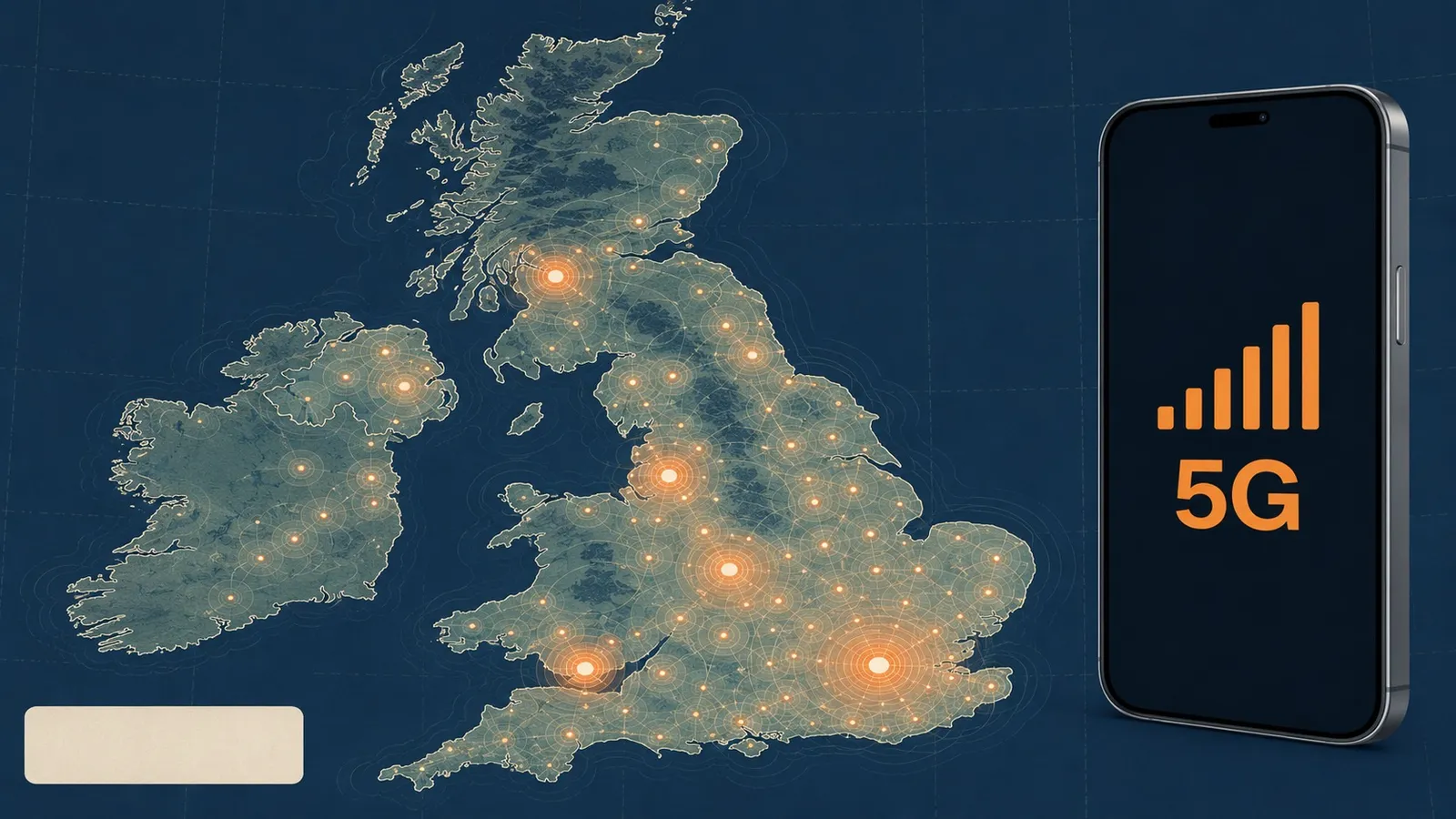
On 13 May 2026 Ofcom published its Spring Connected Nations update, the first official snapshot of UK mobile and broadband coverage in early 2026. The headline figure: the share of UK premises with 5G outdoors from every mobile operator rose from 47% to 64% in just six months, the fastest gain since the technology launched. Here is what the data actually says, what it means for the four networks, and what to do about it if you are choosing or considering switching.
Who Ofcom is and why this report matters
Ofcom is the UK’s communications regulator. Twice a year it publishes Connected Nations, a stocktake of where the country stands on mobile and broadband. The Spring update is a six-month checkpoint between the full annual reports. The figures come from data the four mobile networks themselves submit to Ofcom, audited and standardised against a common methodology. It is the closest thing the UK has to neutral, official coverage numbers. The same data feeds the government’s planning of investment in not-spots and shared rural infrastructure. Everything you see in operator advertising about coverage ultimately compares against this.
The headline numbers

For January 2026, Ofcom reports:
- 5G outdoor coverage of UK premises where every mobile operator has 5G: 64%, up from 47% six months earlier. Ofcom calls this the “from all MNOs” figure.
- 5G coverage range per individual network: 76% to 94% of premises outdoors.
- 5G Standalone (SA) coverage range, across the three networks that have deployed it: 49% to 85%.
- 4G outdoor coverage from all networks combined: 84% of UK landmass, with 96% reached by at least one network.
- 4G outside UK premises: at least 99% from all networks combined.
The most striking line in the Spring 2026 summary is the 47% to 64% jump in “from all MNOs” 5G outdoor coverage of premises, a 17 percentage point gain in half a year. That figure measures the share of UK premises where every one of the four networks has 5G simultaneously, not just where 5G is available from any one of them. Ofcom does not publish individual percentages for EE, Vodafone, O2 and Three in this summary. It gives the range. We will say what that allows you to conclude, and what it does not.
What changed in six months

For the four networks as a group, the range of 5G outdoor coverage has shifted from 69%-89% in the previous reporting period to 76%-94% now. Every operator gained, and the gap between the leader and the laggard narrowed slightly. The big move, though, is in the all-operators-overlap figure. The 47%-to-64% leap means roughly one in six additional UK premises gained 5G coverage from every operator simultaneously in just six months. In consumer language: in many more places you now actually have a choice of network rather than being effectively locked into whichever one happens to cover you.
5G Standalone is where the most movement also happened. The range across the networks that have deployed SA widened from 47%-65% to 49%-85%, meaning the leader on SA is now covering more than 1.7 times the area of the laggard among the deployers. Ofcom specifically notes that “notable increases were observed for the Vodafone and Three networks, particularly in rural areas.” That is unusual phrasing for the regulator and worth pausing on.
5G Standalone is where the real divergence is

A short explainer first. 5G NSA (Non-Standalone) is 5G running on top of an existing 4G core. It gives faster peak speeds in many places but inherits 4G’s limits on latency and capacity. 5G SA (Standalone) is a full 5G network from the radio all the way through to the core. Lower latency (matters for video calls, gaming on the move, AR), bigger capacity (more devices at once without slowing down), and the foundation for newer features like network slicing.
Ofcom reports that three of the four major networks have deployed 5G SA. The one that has not, as of the January 2026 snapshot, is Three. That gap is the most consequential number in the whole report for consumers who care about real-world speed and latency, not just whether any 5G signal exists.
But the gap is closing in a way you would not predict from the data alone. Vodafone and Three have merged into a combined entity, VodafoneThree, with Ericsson supplying the core radio and network infrastructure. Integration of the two networks is in progress. VodafoneThree has publicly committed to bringing 5G SA to 99% of the UK population by 2030 and to every part of the UK by 2034. In practice, Three customers will gain access to SA via Vodafone’s existing infrastructure as the merger proceeds, not by Three building its own SA layer.
What this means for you
If you live in a town or city. Differences between operators on raw 5G coverage have narrowed significantly. Most of the four major networks will give you a usable 5G signal at most addresses in built-up areas. Pick on price, contract terms and customer service, not on coverage marketing. Confirm your specific postcode on Ofcom’s own checker before committing to a 24-month deal.
If you live in a rural area or commute through one. Coverage varies a lot by network. Ofcom’s specific note that Vodafone and Three improved in rural areas matters here, but a 17 percentage point national average jump hides huge local differences. Check your exact postcode and the route you actually drive, not just home, before signing a long contract.
If you care about speed and latency, not just signal bars. This is where 5G SA matters. EE, Vodafone and O2 all have SA deployed. Three customers do not yet, but should gain access via the VodafoneThree merger over the coming years. If you stream HD video on the move, video call from a train, or play online games on the go, an operator with SA already live in your area is the meaningfully better choice today.
If you are with Three and frustrated with speed. You no longer need to switch out of the VodafoneThree group to get SA, since the combined company is integrating Vodafone’s SA over time. But it is worth checking whether your specific area is already on the combined network or still on Three-only equipment.
What the report does not tell you
Four honest limitations to keep in mind.
Per-operator named percentages are not in the headline report. Ofcom gives ranges (76% to 94% for 5G overall, 49% to 85% for SA) without naming which operator sits at which end. The detailed data tables published alongside the report contain finer breakdowns by area, but the top-line summary stays at the range level.
The “from all MNOs” figure is not what most readers assume. When Ofcom writes “Coverage outside premises from all MNOs has increased from 47% to 64%”, it means the share of premises where every operator has 5G, not where at least one of them does. That is what makes the figure lower than any single operator’s individual coverage. It is the more informative consumer metric, because it tells you where you actually have a choice of network, but it is easy to misread.
Indoor coverage is not broken down by operator. Outdoor coverage is much easier to predict than what happens once you walk inside a building. Construction materials and depth from the street can wipe out a signal, and the report does not quantify this by operator.
Coverage is not the same as speed. A network can have 5G available in your area and still struggle at peak times if the local cell is congested. Real-world speed varies by time of day and how many people share the same site.
How to check your own coverage
Three free tools that genuinely help, none requiring an account:
- Ofcom’s own coverage checker: checker.ofcom.org.uk. Lets you compare all four operators at your postcode, for 4G and 5G, indoors and outdoors. The most neutral source.
- The operator’s own checker. Each of EE, Vodafone, O2 and Three publishes one. They tend to be more optimistic than Ofcom but update faster when new sites go live.
- Real speed test: Speedtest by Ookla or the Ofcom Mobile Research app. Coverage tells you a signal exists; a speed test tells you what you actually get.
If a planned switch looks borderline based on these tools, ask the new operator for a no-fault cancellation window when the contract starts. Several offer one.
Sources and methodology
This piece is based on Ofcom’s Connected Nations Spring 2026 update, published 13 May 2026. The data tables behind the figures are linked from that page in XLSX format. All percentages quoted here are verbatim from the Spring 2026 summary or the immediately preceding reporting period (July 2025). Per-operator named figures are not in the headline summary; granular data is available in the linked tables. This piece will be updated as more detailed breakdowns are extracted.
Comments
0 comments
Loading comments…