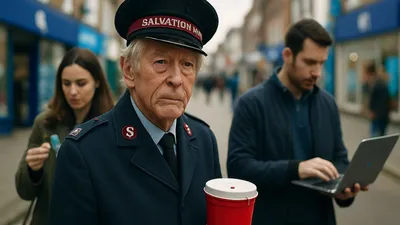
Is John Hurt in The Salvation Army Advert?
John Hurt provided the voiceover for the AIDS campaign in 1986, not the current Salvation Army Christmas appeal asking for £19 donations in 2026.
Background, behind-the-scenes and trivia
Everything else about UK TV ads, production, dogs, locations, scripts, trivia, recurring characters.

Brian Blessed voiced the Flash P&G Dust Magnet advert from 1996, bringing his distinctive tone to UK cleaning product commercials before Hugh Dennis took over the role in 2024.
John Hurt provided the voiceover for the AIDS campaign in 1986, not the current Salvation Army Christmas appeal asking for £19 donations in 2026.

David Tennant voices the Chase Bank UK "Say Hello" advert in 2026, introducing the established brand's UK arm with his cheery voiceover performance.

BBC Radio and Classic FM are among 3400+ free UK radio stations available to stream online in 2026 with no adverts or registration required.

Highclere Castle features in Viking Cruises adverts since 2014, with exclusive Privileged Access experiences available to guests on UK and Ireland river cruise itineraries in 2026.

Katharina Hoffmann plays Aunt Helga in the IONOS UK advert, the character launched in 2021 with a distinctive silver skyscraper hairstyle and jet-propelled heels.
Television advertising has been part of British life since the first commercial aired on ITV on 22 September 1955, a Gibbs SR toothpaste spot that ran at 8:12pm and changed the relationship between broadcasters and commerce forever. In the decades since, the UK has developed one of the most creative and closely scrutinised advertising industries in the world, producing campaigns that range from the warmly nostalgic to the genuinely controversial.
Viewers today are more curious than ever about the mechanics behind the adverts they see. Who is that voice? Where was that filmed? Is that actually a famous actor? These questions drive enormous search traffic, and the answers often reveal something genuinely interesting about how the industry works, the casting choices, the locations scouted, the celebrity deals struck, and the creative briefs that shape what ends up on screen.
This page surveys the broad landscape of UK TV advertising: its regulation, its creative traditions, the celebrities and voices who populate it, and the behind-the-scenes detail that makes individual campaigns memorable. Whether you arrived looking for a specific answer or want to understand the topic more broadly, what follows covers the ground.
All television advertising broadcast in the UK is governed by the Advertising Standards Authority (ASA) and, for broadcast specifically, by Ofcom under the Broadcasting Code. The ASA's broadcast remit is administered through the Broadcast Committee of Advertising Practice (BCAP), which sets the rules on what can be shown, when, and to whom. Ofcom publishes annual data on advertising complaints and upheld rulings, and its records show that misleading claims and harm or offence are consistently the two largest complaint categories.
Scheduling rules matter enormously. Adverts for alcohol, gambling, and certain foods high in fat, salt or sugar face watershed restrictions, meaning they cannot run in or around programmes commissioned primarily for children. The rules are stricter for on-demand services than many viewers realise, the ASA extended its remit to cover video-on-demand advertising in 2016, meaning that a pre-roll ad on a streaming platform is subject to the same standards as a traditional broadcast spot.
One of the most persistent questions about TV adverts concerns who is providing the voiceover. Brands frequently use recognisable voices precisely because familiarity creates warmth, but they do not always publicise the casting. David Tennant voices the Chase Bank UK campaign ({post:unveiling-the-face-behind-the-irresistible-chase-bank-advert-voice}), while Dame Kristin Scott Thomas lent her distinctive tone to Cunard's 2022 campaign ({post:who-voices-the-cunard-advert-2022}). Both choices reflect a broader strategy of pairing premium or aspirational brands with actors who carry cultural authority rather than celebrity novelty.
The use of celebrity voices is not without risk. When a well-known actor's personal reputation shifts, brands can find themselves quietly distancing from campaigns mid-flight. Conversely, a voice that becomes strongly associated with a brand can outlast the original talent, Brian Blessed's work on Flash cleaning products is a good example of a voice that became almost inseparable from the brand identity ({post:does-brian-blessed-do-the-flash-advert}). The late John Hurt is another figure whose voice appears in public memory attached to campaigns he did not actually make, a reminder that viewer recollection of adverts is often unreliable ({post:is-john-hurt-in-the-salvation-army-advert}).
Location scouting for TV commercials is a specialist discipline, and the results are frequently surprising. Luxury and lifestyle brands often film abroad to access light, architecture or landscape unavailable in the UK, while heritage brands tend to anchor their campaigns in recognisably British settings. The Birra Moretti 'Chairs' campaign, for instance, was filmed in Tuscany to reinforce its Italian identity ({post:where-is-birra-moretti-advert-filmed}), whereas Land Rover used Harewood House in West Yorkshire, a 4,000-acre estate, to frame the Range Rover Sport as a vehicle of understated British grandeur ({post:where-is-the-land-rover-advert-filmed}).
Viking Cruises takes a different approach, using its advertising locations to do double duty as destination inspiration. Highclere Castle, the real-life setting for Downton Abbey, has featured in Viking's UK campaigns since 2014, lending the brand an association with privileged access to historic Britain ({post:where-are-viking-cruises-advert-filmed}). The strategy works because the advert itself becomes a kind of travel content, blurring the line between commercial and editorial.
Some British adverts have achieved a cultural longevity that far exceeds their original broadcast run. The Cadbury Gorilla (2007), the John Lewis Christmas campaigns from 2011 onwards, and the Compare the Market meerkats are all examples of creative work that generated sustained media coverage, social sharing, and, crucially, measurable sales uplift. The Go Compare tenor, Gio Compario, first appeared in autumn 2009 and became one of the most complained-about characters in UK advertising history, which paradoxically made the brand impossible to ignore ({post:when-was-the-first-go-compare-advert}).
The Christmas advert has become a peculiarly British institution. John Lewis, Marks and Spencer, Sainsbury's and Boots now treat their festive campaigns as major cultural events, with launch dates tracked by marketing press and viewing figures reported as news. According to Thinkbox, the TV advertising marketing body for commercial broadcasters, Christmas ad spend by UK retailers has grown consistently year-on-year, with total TV ad spend across all sectors reaching approximately £5.5 billion in 2023.
Advertising characters and animals generate their own category of viewer curiosity. The dog in the Flash cleaning products advert prompted widespread debate about its breed, it is a Labradoodle, a crossbreed first developed by Wally Conron in Australia in 1989 ({post:is-the-dog-in-the-flash-advert-a-labradoodle}). The Labradoodle's appeal to advertisers is partly practical: its hypoallergenic coat and photogenic appearance make it a reliable on-set performer, and its relative novelty as a breed still carries a certain lifestyle connotation.
Recurring human characters in adverts serve a similar function to soap opera figures, they build familiarity across multiple spots and give viewers someone to follow. Katharina Hoffmann's portrayal of Aunt Helga in the IONOS UK campaign is a strong recent example: the character's distinctive silver skyscraper hairstyle and deadpan delivery made her immediately recognisable from 2021 onwards ({post:who-plays-aunt-helga-in-ionos-advert}). When a character lands well, brands tend to extend the campaign rather than retire it, which is why some figures persist on screen for years.
Television remains the single largest advertising medium in the UK by spend, though its share of total ad budgets has been under sustained pressure from digital channels since the mid-2010s. Ofcom's annual Communications Market Report consistently shows that adults in the UK still spend more time watching broadcast and on-demand television than any other video medium, which underpins the continued commercial logic of TV advertising even as viewing habits fragment. Linear TV viewing among adults aged 16 to 34 has fallen sharply, but older demographics remain highly reachable through broadcast.
The cost of a primetime slot on ITV1 varies enormously depending on the programme, the time of year, and the length of the spot. A 30-second slot during a major live event, the final of a talent show, a World Cup match, can cost upwards of £250,000 for a single transmission, according to figures cited by industry body ISBA. Production costs for a high-end campaign are separate and can easily match or exceed the media buy, particularly when celebrity talent, overseas locations and post-production visual effects are involved.
The Advertising Standards Authority (ASA) handles complaints about broadcast advertising, operating through the Broadcast Committee of Advertising Practice (BCAP). Ofcom sets the broader broadcasting framework under its Broadcasting Code and has ultimate enforcement powers for licensed broadcasters.
Brand websites and official press releases sometimes credit voiceover artists, but many campaigns are deliberately uncredited to keep the focus on the product. Fan forums such as Digital Spy and dedicated sites like Advert Music often crowdsource identifications, and the ASA can require brands to be transparent about celebrity endorsements if asked.
No. Ofcom and BCAP rules restrict certain categories of advertising to post-watershed slots (after 9pm). These include adverts for gambling, alcohol, and foods high in fat, salt or sugar when they are likely to appeal to children. Some categories, such as explicit sexual health advertising, face even tighter scheduling restrictions.
The character Gio Compario, played by Welsh tenor Wynne Evans, first appeared in Go Compare adverts in autumn 2009. Despite consistently ranking among the most complained-about characters in UK advertising, the campaign ran for many years because the brand recognition it generated was commercially effective.
Brands sometimes prefer anonymous celebrity voiceovers so that the talent's public persona does not overshadow the product message. There is also a commercial logic: an unnamed voice can be replaced without disrupting brand continuity if the talent becomes unavailable or controversial.
No. The BBC is prohibited from carrying advertising or sponsorship on its UK public services under the terms of its Royal Charter and the BBC Agreement. This is why BBC Radio stations are ad-free, unlike commercial stations, though the BBC does promote its own programmes during natural breaks.
Production costs vary enormously. A simple local or regional spot might cost a few thousand pounds, while a high-end national campaign involving celebrity talent, overseas filming and significant post-production can run to several million pounds before a single media buy is made. The Christmas campaigns produced by major retailers are typically among the most expensive annual productions in UK advertising.
The British Film Institute (BFI) holds an extensive archive of British advertising, and selected material is accessible through BFI Player. The History of Advertising Trust (HAT) in Norwich also maintains a substantial physical archive. Many classic spots have been uploaded to YouTube by brands themselves or by enthusiast channels.
TV advertising in the UK is a richer subject than its 30-second format might suggest. Behind each spot is a chain of decisions about casting, location, tone, scheduling and spend, decisions that reflect both the brand's commercial priorities and the cultural moment in which the advert was made. The questions viewers ask most often (who is that voice, where was that filmed, is that really who I think it is) are not trivial: they are the natural response to creative work that has lodged itself in the memory.
The articles collected in this category tackle those questions directly, drawing on production credits, location research and industry sources to give accurate answers rather than speculation. If you have landed here looking for something specific, the pieces linked throughout this page are a good place to start. If you are browsing more broadly, the topic repays attention, British TV advertising has a history that is genuinely worth knowing.