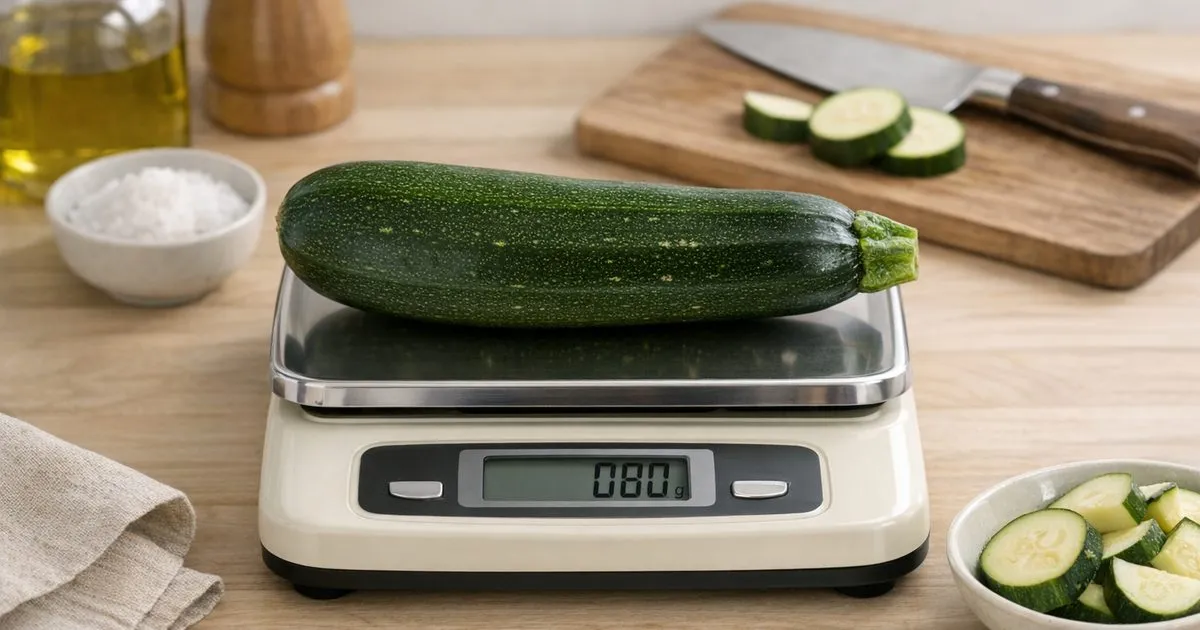
Image illustrative, generated with AI for editorial purposes.
Image illustrative — generated with AI for editorial purposes.
How Much Does a Courgette Weigh? The Ultimate Guide to Courgette Weight and Measurements
A typical courgette weighs between 250 and 500 grams, according to Veggipedia. Most supermarket courgettes sit in the middle of that range, so if a recipe calls for "one courgette" without specifying weight, budgeting around 300 g is a reasonable working figure. For anything where precision matters, a kitchen scale is the only reliable answer.
What is the average weight of a courgette in grams?
Veggipedia puts the average courgette at 250-500 g, with a length of 10-25 cm. That is quite a spread, because courgettes are sold at very different stages of maturity. A slim, bright-green courgette from Tesco or Sainsbury's is usually at the lower end, around 200-280 g. A larger one, the kind you find at a farm shop or accidentally leave growing in the garden for a week too long, can easily tip 400-500 g or beyond.
Older guides on this topic often quoted 150-250 g as the typical range. That figure is on the low side for 2026 UK supermarket stock, where medium courgettes tend to run heavier. Weighing your courgette takes about three seconds and removes all the guesswork.
Why does courgette weight matter for cooking?
Recipes that use courgette as a filler vegetable, think ratatouille or a pasta sauce, are fairly forgiving. A 50 g difference will not ruin anything. Weight becomes more important in baking (courgette loaf, courgette brownies) or spiralised dishes, where the volume of the finished ingredient changes the texture of the whole dish. If a recipe specifies 300 g of grated courgette, that is the figure to hit.
Calorie and macro tracking is the other reason people want a specific number. A raw courgette contains roughly 17 kcal per 100 g, so the difference between a 200 g and a 450 g courgette is about 43 kcal. Small, but useful if you are logging carefully.
How do commercial and restaurant courgettes differ in size?
Professional kitchens buy courgettes in bulk, and the specifications look quite different from a loose supermarket bag. Classic Fine Foods, a UK fine-foods supplier, lists commercial courgette carton and pack weights ranging from 0.5 kg to 7 kg, with piece counts per carton running anywhere from 5 to 32. That means a single carton might hold five large courgettes or 32 smaller ones, depending on the grade ordered.
Classic Fine Foods also notes that piece weight conforms to the current GB/EU DEFRA Grading and Marketing Standards (GMS), which sets minimum quality and size thresholds for fresh vegetables sold commercially in Great Britain. Commercial courgettes arrive fresh, whole, and either loose or pre-packed in cardboard trays, lidded trays, or telescopic boxes.
For home cooks, none of this changes the practical answer. It does explain, though, why restaurant dishes can feel more consistent: chefs are ordering to a graded spec rather than picking whatever is left on the shelf.
How should you measure a courgette at home?
A digital kitchen scale is the simplest approach. Place the courgette on the scale whole, note the weight, then prep it as the recipe requires. If you only have a measuring tape, length gives you a rough proxy: a 15 cm courgette is usually around 200-250 g, and a 22 cm one is likely 350-450 g, though width varies enough to make length alone unreliable.
If a recipe from a US source refers to "one zucchini," that is the same vegetable. American recipes often assume a slightly smaller specimen than UK ones, so if the dish seems saucy or wet after cooking, you may have used more courgette than the original intended.
Does courgette weight change after cooking?
Yes, significantly. Courgette is about 95% water. Roasting, frying, or grilling drives off a large amount of that moisture, and quickly. A 300 g raw courgette can lose 30-40% of its weight when roasted at 200°C for 20 minutes, leaving you with roughly 180-210 g of cooked vegetable. Salting and draining raw grated courgette before baking removes even more liquid, which is why recipes for courgette fritters or bread specifically ask you to squeeze out the excess water first.
If you are scaling a recipe up or down, always weigh raw. Cooked weights vary too much depending on heat, time, and how much surface area the courgette had.
Picking the right courgette at the supermarket
For most recipes, a courgette in the 200-300 g range is the most practical size. It is easy to handle, cooks evenly, and matches what most UK recipe writers have in mind when they say "one courgette." Avoid anything that feels spongy or has soft patches near the stem; that signals the flesh inside will be watery and slightly bitter. Firm, glossy skin and a tight stem end are the signs of a good one.
Frequently asked questions
- how much does one courgette weigh in grams
- A typical courgette weighs between 250 and 500 grams according to Veggipedia. Most supermarket courgettes fall in the middle of that range, around 300 grams, though smaller ones from major retailers like Tesco or Sainsbury's may be 200-280 g, while larger farm shop varieties can reach 400-500 g or more.
- what is the average length of a courgette
- The average courgette is between 10 and 25 centimetres long, according to Veggipedia. The variation in length reflects different maturity stages, with younger courgettes being shorter and lighter, and more mature ones being longer and heavier.
- how many courgettes in a 1kg pack
- A 1 kg pack typically contains 2-4 courgettes, depending on their individual size. Since courgettes range from 250-500 grams each, a kilogram carton could hold anywhere from 2 larger specimens to 4 smaller ones.
- do I need to weigh courgettes for recipes
- For recipes using courgette as a filler vegetable like ratatouille or pasta sauce, weighing is not essential as a 50 gram difference won't affect the result. However, for baking (courgette loaf or brownies) or spiralised dishes, weighing ensures the correct volume and texture, so a kitchen scale is recommended for precision.
- how much does a medium courgette weigh
- A medium courgette typically weighs around 300 grams, which sits in the middle of the 250-500 gram range. This is a reasonable estimate when a recipe simply calls for 'one courgette' without specifying an exact weight.
Was this article useful?
Thanks — your feedback was recorded.
Sources
- Veggipedia - Courgette (www.veggipedia.nl)
- [PDF] Courgettes - Classic Fine Foods (classicfinefoods.co.uk)
Comments
0 comments
Loading comments…